



Built for people shipping software with AI
    ✦ Open Source · Apache License 2.0
    Trust your coding agents with real work

    Give coding agents more work. Watch them less. Ship more.

    MartinLoop keeps the job focused, bounded, checked, and accountable — so you can stop babysitting agents and ship more.

    Give it the job. Walk away.

    MEMBER OF
    NVIDIA Inception ProgramAWS ActivateGoogle for Startups
    Works withClaude Code·Codex CLI·Gemini CLI·MCP
    Animated MartinLoop CLI: martin run 'fix flaky CI' --budget-usd 3 --verify pnpm test, JSONL output, completed run

    Give it the job. MartinLoop watches the run.

    One unattended run cost $65. The bigger cost was having to supervise everything.

    The problem

    AI was supposed to save you time. Why are you still watching it work?

    Coding agents can write more software than ever. But if you still have to watch every move, check every claim, and clean up every bad loop, you did not really delegate the job.

    🔍

    “Is it actually done?”

    The agent says yes. You still have to check everything.

    🎯

    “Why is it changing that?”

    One task quietly turns into changes you never asked for.

    ⏳

    “Why is it trying the same thing again?”

    The loop keeps running even when progress has stopped.

    🧩

    “Did it break anything?”

    A fix in one place can create three new problems somewhere else.

    🧾

    “How much is this costing me?”

    Retries keep spending while you wait for a useful result.

    🌊

    “Can I leave this alone for an hour?”

    If the answer is no, the agent is still creating a management job for you.

    🤝

    You should not have to supervise software that was supposed to automate the work.

    The new bottleneck is trust. MartinLoop was built after a $65 overnight run showed us how costly constant supervision had become.

    "My costs are going up three times every three months. My revenues are not. Everybody has gotten infatuated with Ralph Wiggum loops."

    — Chamath Palihapitiya, All-In Podcast #263, March 2026
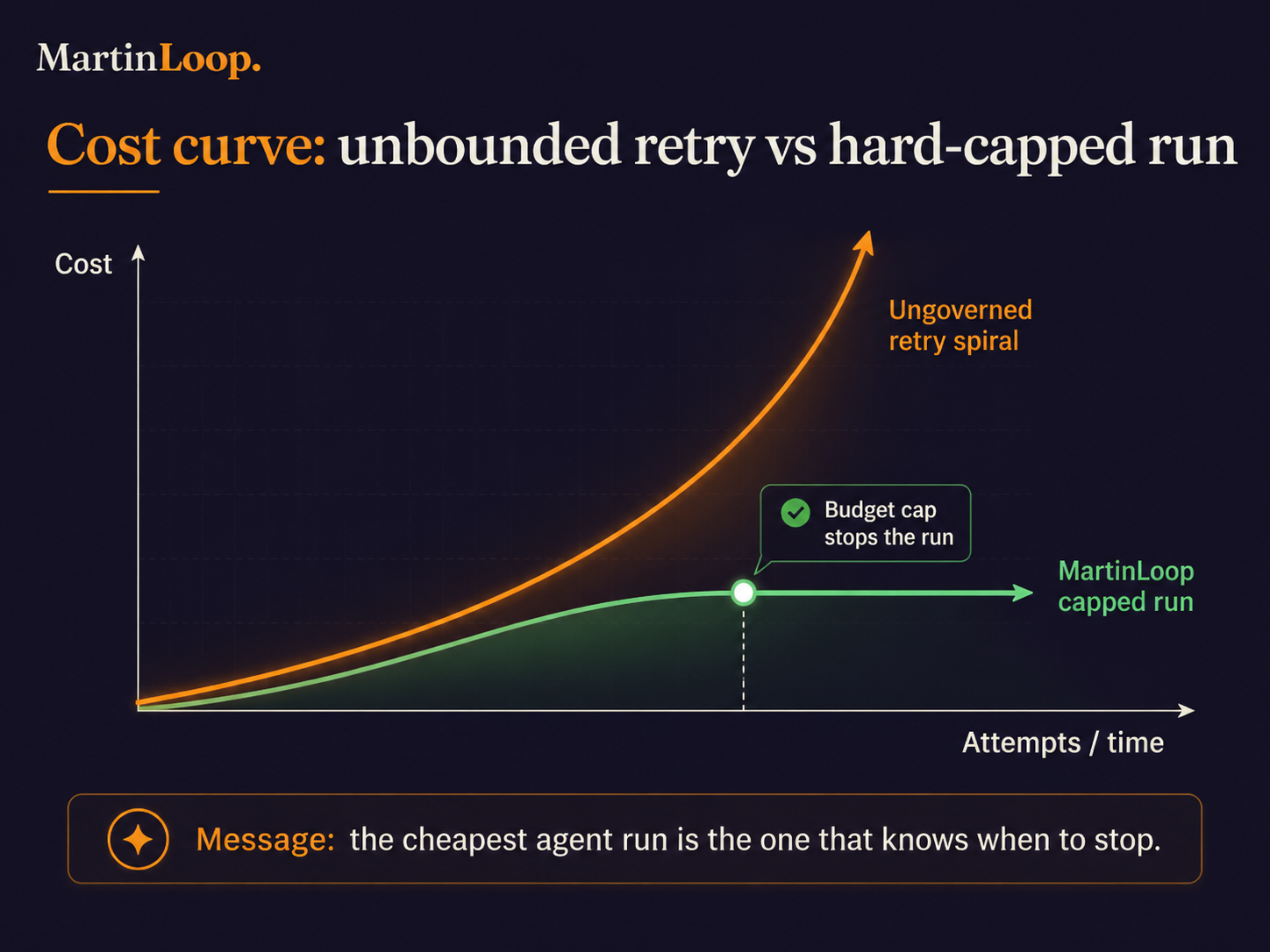
    Cost curve comparing unbounded retry spend with a hard-capped MartinLoop run
    55.8%
    Lower cost on one published benchmark task — $5.20 → $2.30 on the same flaky-CI-gate task.
    1 vs 4
    One attempt versus four failed retries. Same benchmark. Same configured verifier.
    $0
    Open-source core. Apache 2.0. No account required to start.

    Benchmark results are task-specific, not a guarantee for every run.

    HOW IT WORKS

    Give it the job. Walk away.

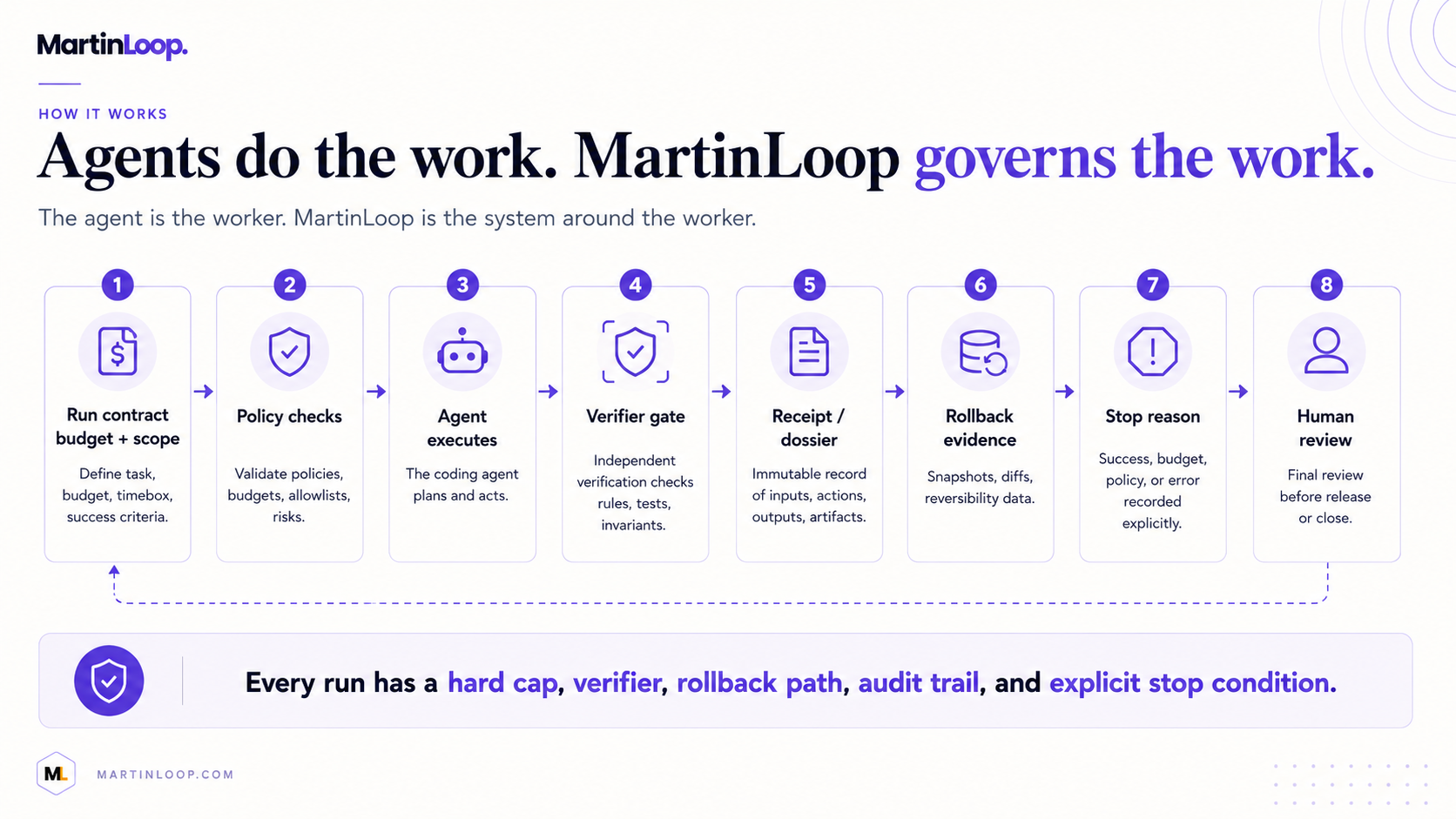
    Your coding agent still does the coding. MartinLoop keeps the work accountable while you do something else.

    1

    Define the job

    Set the scope, goal, budget and what success looks like.

    2

    Set limits

    Budget, iterations, time and path limits are agreed before the agent starts.

    3

    Let the agent work

    The coding agent — Claude Code, Codex, Gemini CLI or another — plans and acts.

    4

    Keep it focused

    Drift, runaway retries and runs that stop making sense are cut short.

    5

    Check the work

    Configured tests and evidence run before the result is accepted.

    6

    Recover when needed

    Enough state and evidence is preserved to retry, repair or hand off cleanly.

    7

    Close the run

    Every run ends as VERIFIED, STOPPED or NEEDS REVIEW, with the stop reason recorded.

    8

    Inspect what happened

    The receipt shows what finished, what failed and what it cost.

    Reliable agents should not need constant supervision.

    MartinLoop workflow: 8 steps that happen on every run
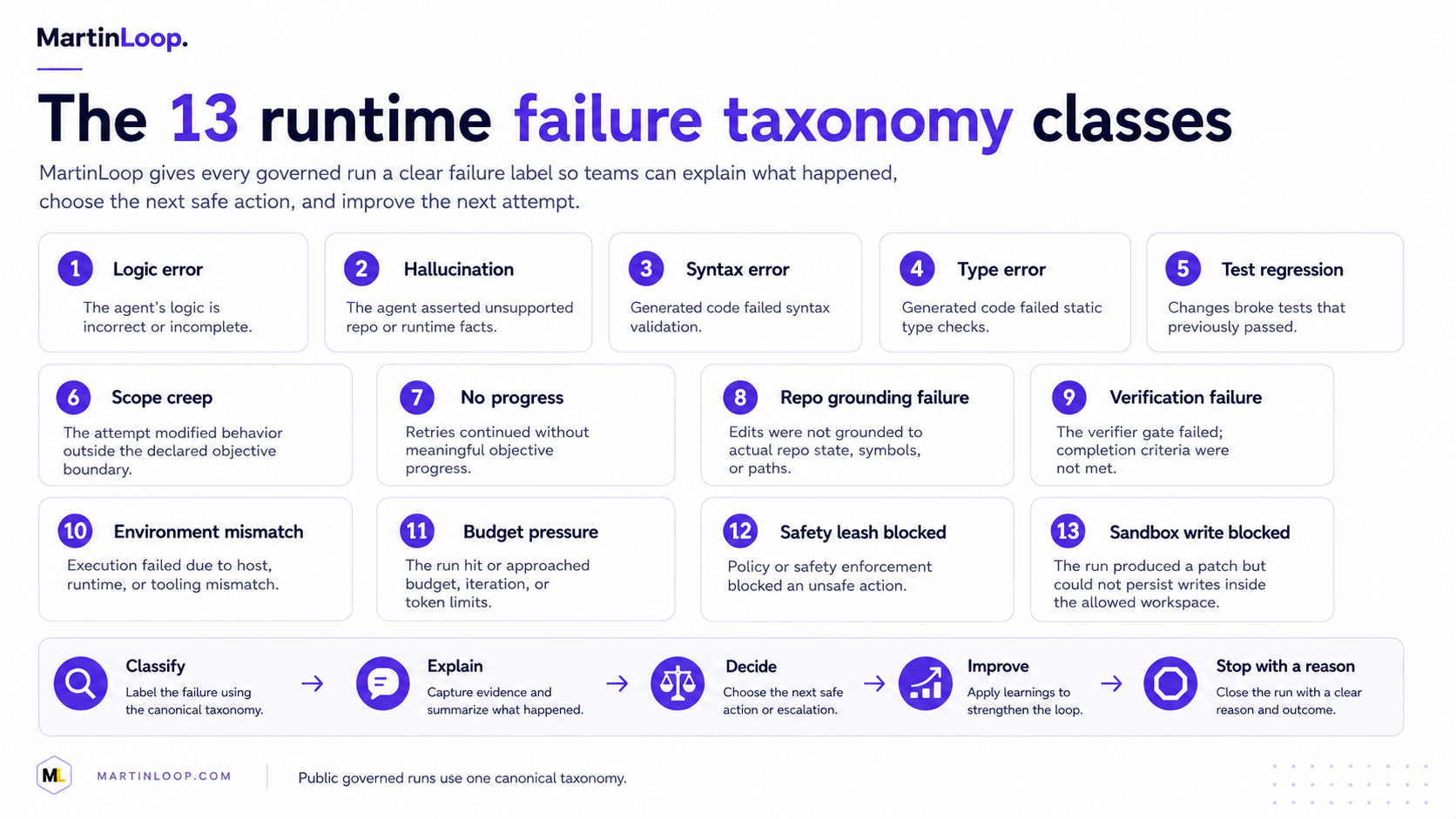
    Step 2 in detail · what MartinLoop catches
    The 13 runtime failure taxonomy classes used by MartinLoop, from logic error through sandbox write blocked
    Run record

    Know what happened without reconstructing the run yourself.

    MartinLoop keeps the job, attempts, checks, stop reason, recovery information, and cost together so you do not have to piece the story together from terminals, Git history, and billing dashboards.

    One npm install. That's the whole setup.

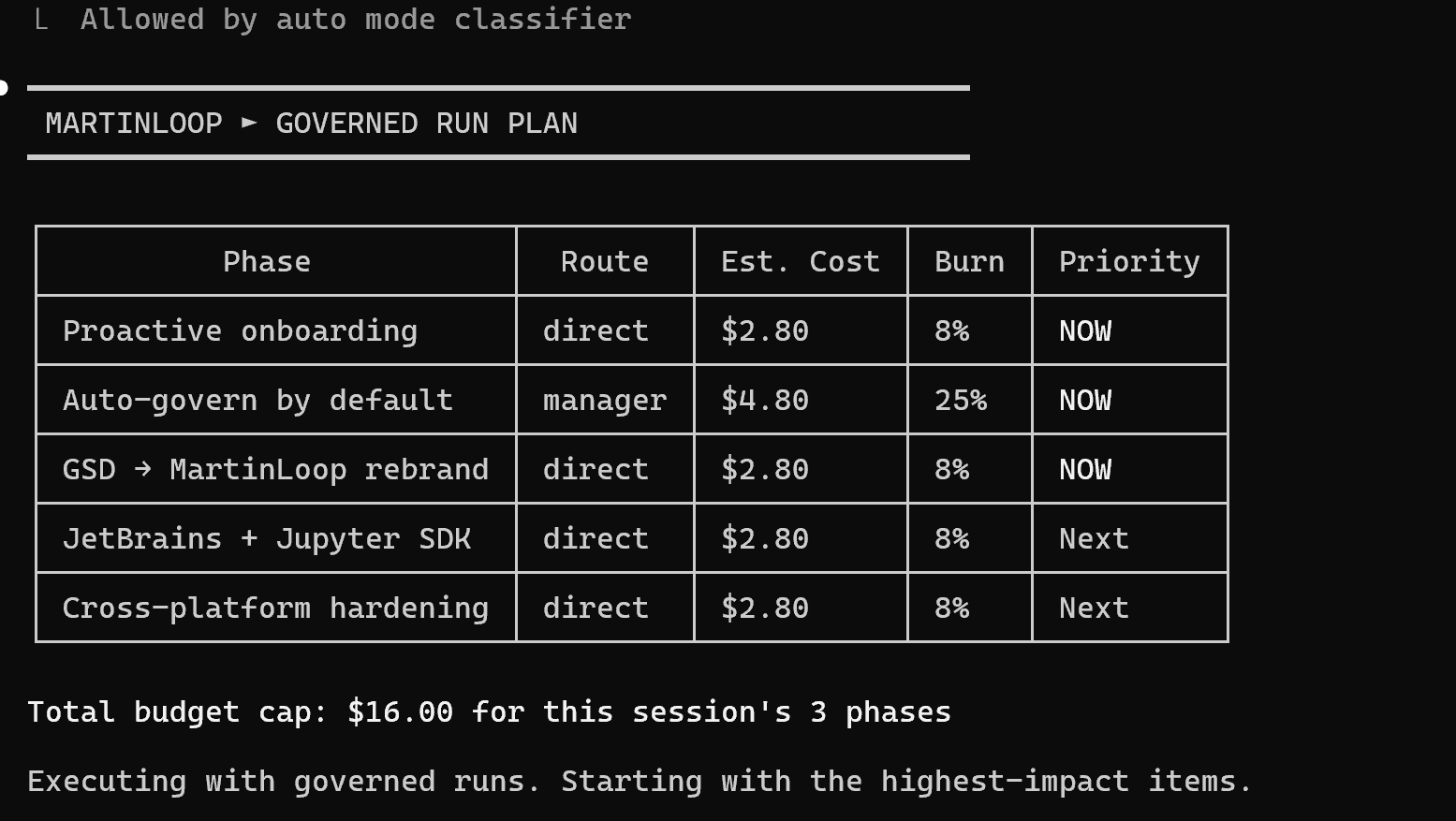
    MartinLoop governed run plan: phases, routes, estimated cost, burn, priority, and a total budget cap of $16 across 3 phases
    Before the runGoverned budget plan
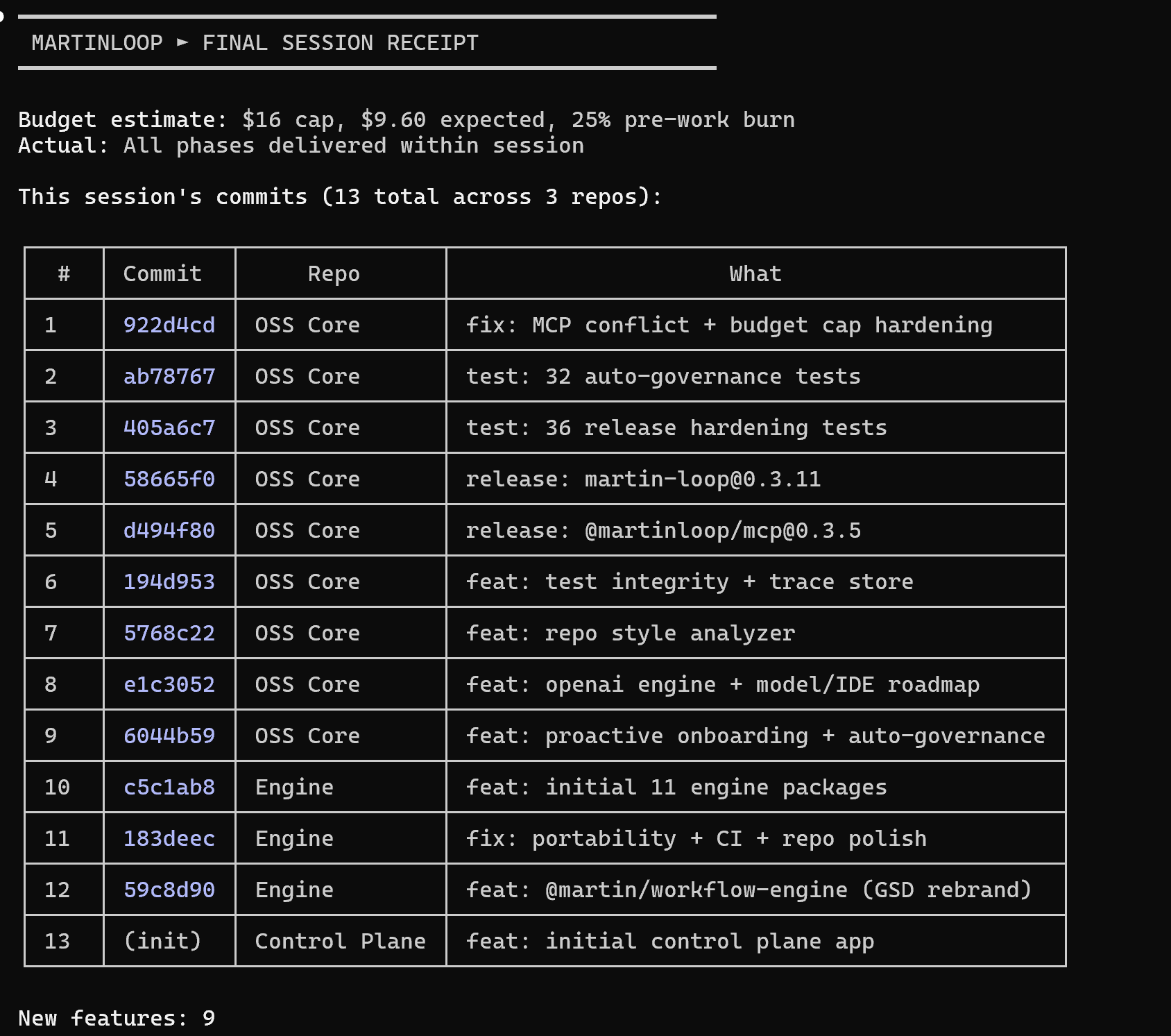
    MartinLoop final session receipt: budget estimate versus actual, 13 commits across 3 repos, 9 new features
    After the runFinal session receipt
    Keep the tools you like

    Your coding agent does the work. MartinLoop makes the job dependable.

    Keep Claude Code, Codex, Gemini CLI, your IDE, Git workflow, CI, and the tools your team already trusts. MartinLoop handles the boundaries, checks, recovery, and run history around the job.

    MartinLoop running the job around Claude Code, Codex, Gemini and custom agents
    Sits where you already work — CLI, IDE, CI

    One system around the coding agents you already use.

    Native coding agents and OpenAI-compatible model endpoints use different execution paths. MartinLoop keeps the job, limits, checks, recovery, and history consistent without presenting raw model endpoints as finished autonomous coding workers.

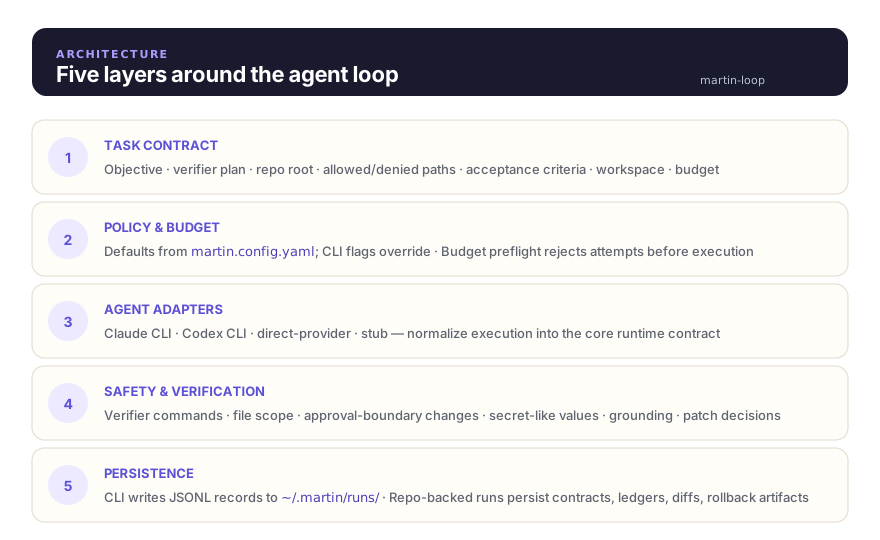
    How MartinLoop sits between your coding agent and the model providers
    Early access

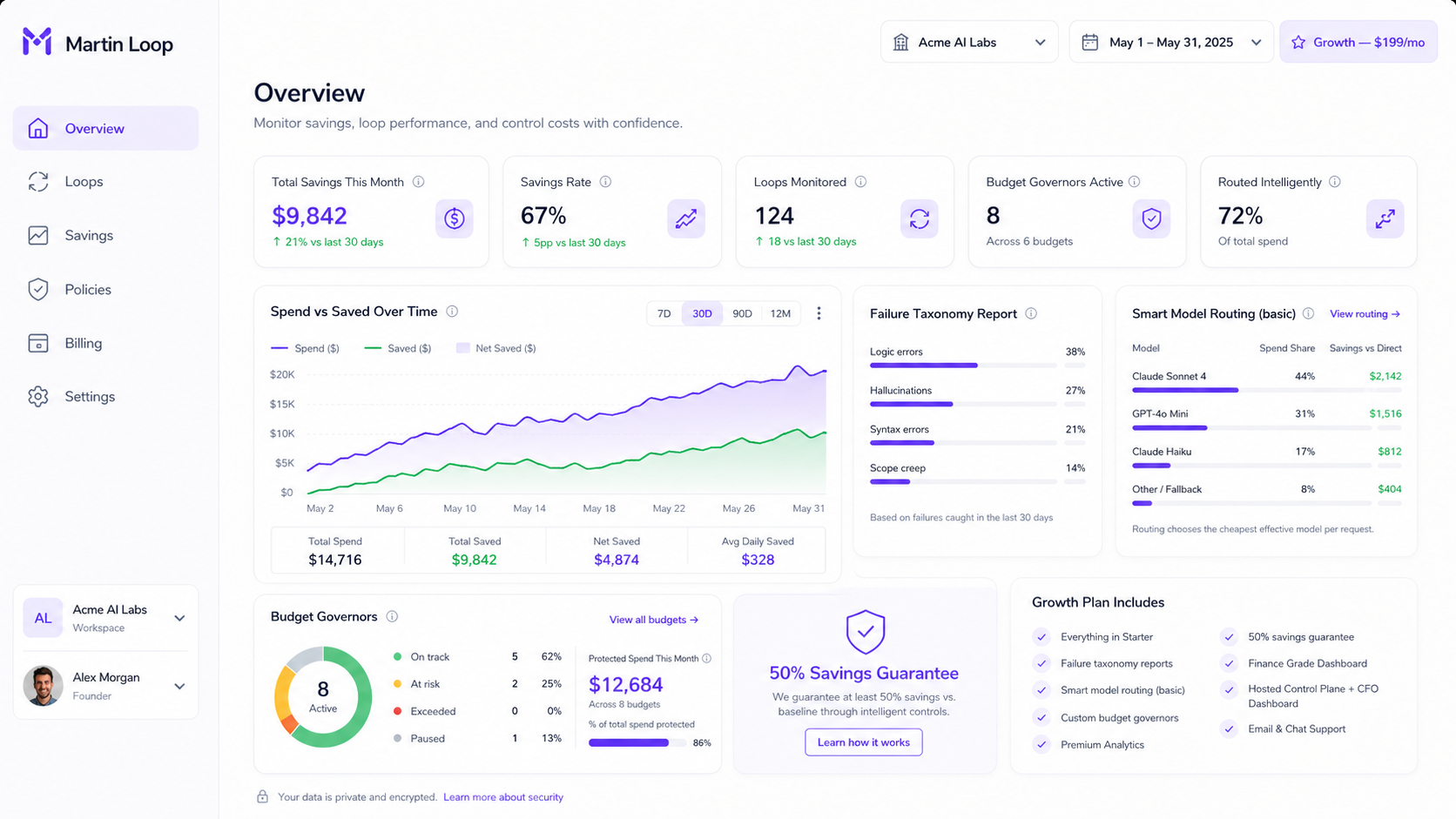
    Know what your AI team actually got done.

    When one agent becomes many agents and one repo becomes many repos, MartinLoop gives the team one place to see outcomes, failures, and spend.

    MartinLoop Dashboard showing cost analytics and loop telemetry
    Loop Heatmap

    Every agent run visualized. See where work is concentrated, where it stalls, and where you can cut.

    What's failing and why

    Understand what types of problems your agents hit most — and how often each one gets resolved.

    Where your spend goes

    See cost by run, by task, by model — broken down in a way your team and leadership can actually act on.

    Every budget decision, logged

    A full record of every limit hit, every stopped run, and every outcome. Reviewable at any time.

    Why MartinLoop

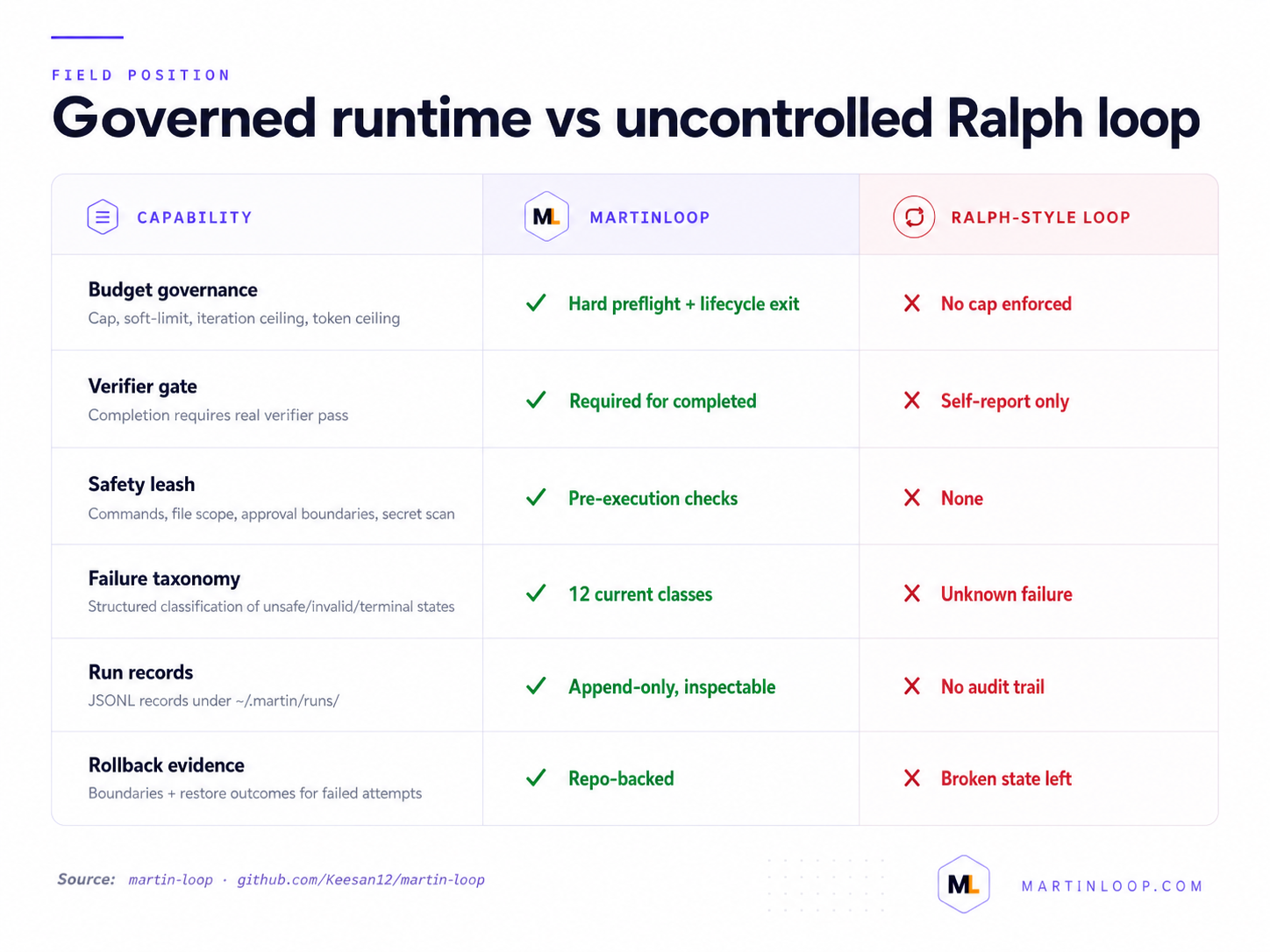
    The difference is accountability.

    The goal is not more control for its own sake. It is confidence to delegate more work.

    Capability matrix: controlled runtime versus uncontrolled loop
    Model-agnostic by design

    Change the AI. Keep the trust.

    The job, the limits, the verification, the recovery and the run record stay the same even when the agent or the model underneath changes. That is the point: you are not locking your process to one vendor's tooling.

    Native coding agents

    Claude Code · Codex · Gemini CLI

    The agent already knows how to work in your repo. MartinLoop runs the job around it — scope, limits, verification, stop reasons and a run record you can read afterwards.

    OpenAI-compatible providers

    Hosted and local endpoints

    Available for compatible inference workflows. Full governed workspace editing on this path is being hardened before we promote it, so we do not claim it as a finished coding worker yet.

    Same job contract. Different worker. How model-agnostic execution works →

    Keep your agents

    One system around the coding agents you already use.

    Keep the coding agents, IDE, Git workflow, repository host, CI and specialist tools you already like. MartinLoop handles the work around the coding-agent job, so you do not have to rebuild the same glue around every agent.

    • ✓ Model- and IDE-agnostic: Claude Code, Codex, Gemini CLI, Cursor, MCP hosts
    • ✓ The same job definition, limits and checks wherever you work
    • ✓ Run records you own — no provider lock-in
    • ✓ Open-source Apache 2.0 core — fork it, self-host it, audit it
    Open source

    MartinLoop Core is Apache 2.0 licensed and free to use. Hosted dashboard and team features are in early access. Get early access →

    What MartinLoop is

    The system around the coding agent.

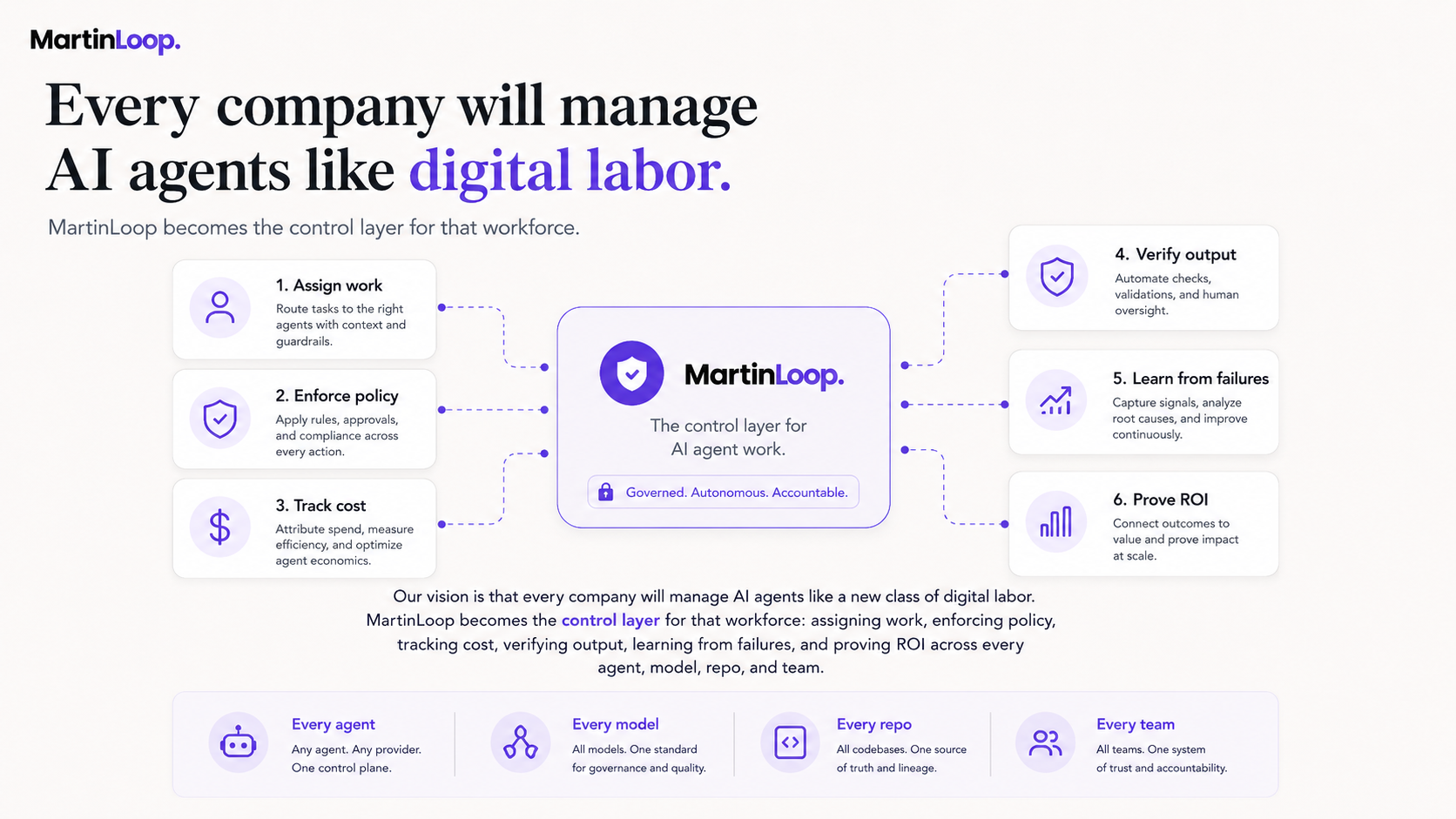
    MartinLoop helps builders and teams give coding agents larger software jobs without supervising every step. It keeps the work focused, stops waste, checks the result, helps recover when things break, and shows what finished, what failed and what it cost. The coding agent still writes the code.

    Built for builders, technical founders and engineering teams who want to delegate more real software work to agents without runaway cost, unchecked scope, or no record of what happened.

    What MartinLoop does

    • Sets a real spending limit before the run starts
    • Only marks a run done when the work actually passes
    • Keeps a full record of every run — replayable, inspectable
    • Gives agents boundaries they can't reason their way around
    • Stops automatically when progress stalls
    • Reports the true cost — including every token spent

    Who it is for

    • Engineering teams running AI coding agents in production
    • Platform teams building safe agent workflows
    • CTOs and heads of engineering managing AI tooling risk
    • Founders who need to show ROI on AI spend to investors
    • Engineering managers who report AI cost to finance
    • Developers who want AI help without runaway behavior
    • Organizations that need auditability and reproducibility

    Read the MartinLoop FAQ · the complete guide to agent loops & Ralph loops · coding-agent reliability · open-source GitHub repository

    Where this is going

    Coding is only the beginning.

    Now

    Make coding agents dependable

    Clear jobs. Hard boundaries. Checks. Recovery. Explicit outcomes.

    Next

    Help teams manage more agent work

    Shared history, team visibility, and better understanding of where agents succeed or fail.

    Later

    Extend accountability

    Bring the same accountability to other consequential AI work. Roadmap.

    Next and Later are roadmap, not shipped. The model will change. The need to trust the work will not.

    Atlas · Now in the paid dashboard

    Your agents already make mistakes. Atlas makes sure you learn from them.

    MartinLoop governs the run. Atlas records what happened. SANSA trace intelligence finds the evidence-backed pattern behind failures, retries and wasted spend. Governed learning turns repeated evidence into controlled improvement candidates.

    Atlas

    The black box recorder for coding-agent runs, receipts, failures, spend and recovery.

    SANSA Trace Intelligence

    Connects the trace into recurring failure patterns and evidence-backed explanations.

    Governed Learning

    Surfaces evaluated improvement evidence with approval and rollback boundaries before behavior changes.

    Give your agents more responsibility without giving them unlimited freedom.

    Join the early-access group for the hosted dashboard and team workflows.

    Free forever on the open-source tier. No credit card. We only use this to sequence outreach — request deletion anytime at help@martinloop.com.