Agent loops, AI loops & Ralph loops — and how to make them safe.
Published May 8, 2026 · Last updated May 10, 2026 · 6 min read
Jump to: Watch a governed Claude Code loop vs an ungoverned Ralph loop · How MartinLoop governs every agent loop · MCP server for Claude Desktop, Gemini & Cline
Every modern AI coding agent — Claude Code, OpenAI Codex, Gemini agents, Devin, OpenHands, custom LangGraph and AutoGen pipelines — runs as a looping agent. The loop is what makes them powerful. The loop is also what makes them dangerous.
What is an agent loop?
An agent loop is the iterative cycle an LLM-driven agent runs through to complete a task: observe the environment, plan the next step, act via a tool call, then verify the result. The loop repeats — sometimes hundreds of times per task — until either the task is complete, a stop condition fires, or the operator gives up.
Agent loops are also called agentic loops, autonomous loops, LLM loops, or simply AI loops. The terminology is interchangeable. The risk is the same: ungoverned, agent loops can spend unbounded time and money chasing a goal they will never reach.
What is a Ralph loop?
A Ralph loop is the canonical failure pattern of autonomous coding agents. The agent enters a cycle where it keeps trying — and keeps failing — without making real progress. It re-edits the same broken file, re-runs the same flaky test, re-asks the same hallucinated question. The token meter keeps spinning. The bill keeps growing. Nothing ships.
The name comes from the AI coding community describing the way these loops feel like a confused character bouncing off the same wall forever. Ralph loops are not a Claude problem or an OpenAI problem — they are an orchestration problem. Any looping agent without a hard budget stop and an evidence-gated exit will eventually Ralph.
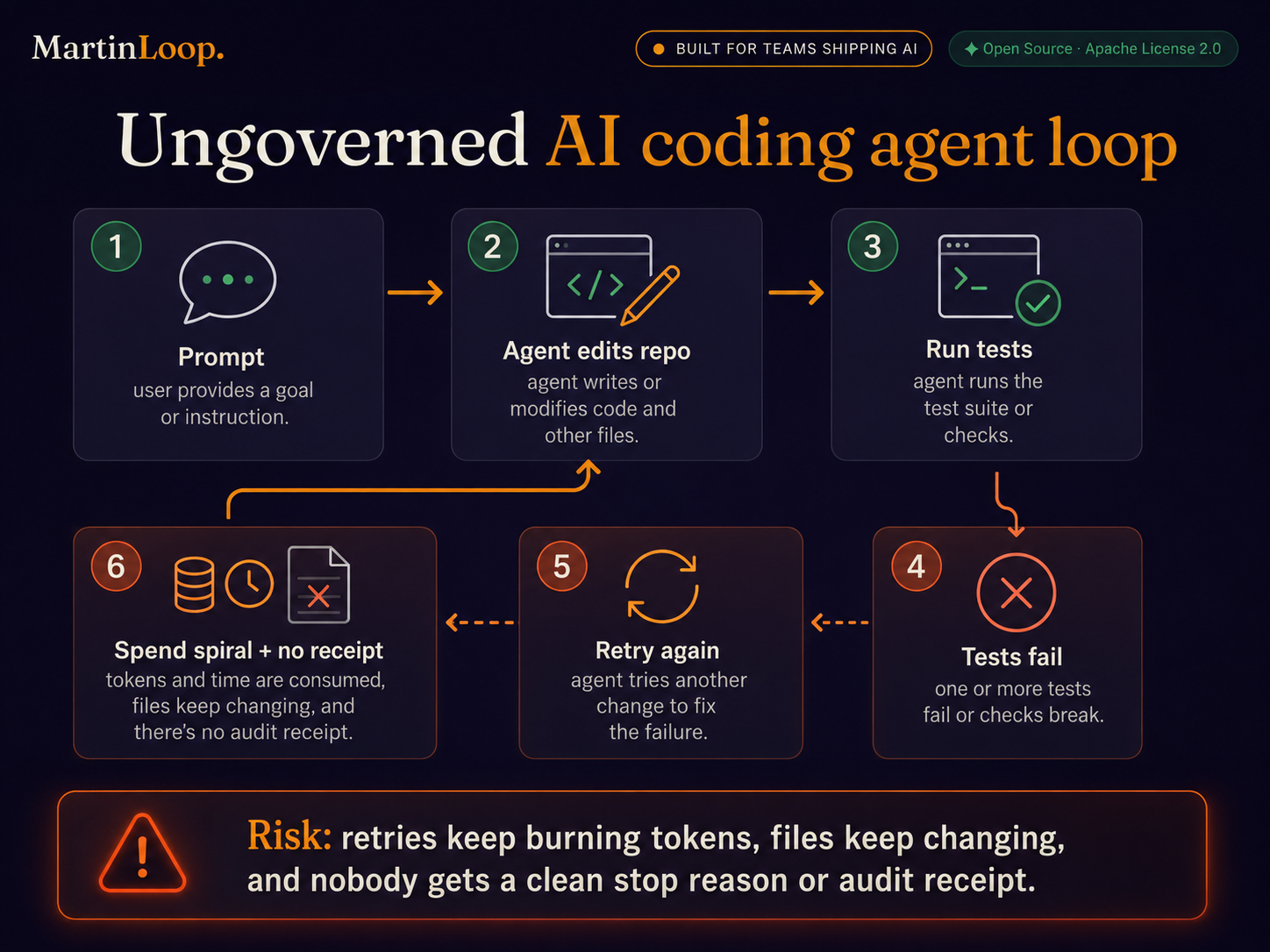
Claude loops, Claude Code loops, Codex loops
Claude loops and Claude Code loops are agent loops driven by Anthropic's Claude models, typically through the Claude Code CLI. Because Claude's reasoning tokens are billed, a single ungoverned Claude Code loop chasing a flaky test can spend $10+ before a human notices.
Codex loops are the OpenAI Codex equivalent — same failure modes, same cost dynamics. Gemini agent loops, Devin loops, and OpenHands loops all share the same orchestration problem.
MartinLoop is provider-agnostic. The same martin run --budget-usd 3 --verify primitive governs Claude loops, Codex loops, and any custom LangGraph or AutoGen pipeline.
See the runtime controls for Claude Code & Codex loops — every governance primitive MartinLoop ships, in one place.
The 13-class failure taxonomy of autonomous loops
Thirteen specific ways an agent loop goes wrong. Each one gets tagged in the run record so you can see — at a glance — what actually went sideways instead of scrolling logs.
- Logic error — the code runs but does the wrong thing.
- Hallucination — the agent invents an API, file, or library that doesn’t exist.
- Syntax error — the patch literally won’t parse.
- Type error — the change breaks the type system.
- Test regression — fixing one test breaks another.
- Scope creep — the agent touches files it wasn’t supposed to.
- No progress — same edit, same failure, on repeat. Classic Ralph.
- Repo grounding failure — the agent doesn’t actually understand the codebase it’s editing.
- Verification failure — your
--verifycommand says no. - Environment mismatch — works on the agent’s machine, not on yours or in CI.
- Budget pressure — the run is approaching the cap and the next attempt would breach it.
- Safety leash blocked — the agent tried to do something policy-as-code refused (out-of-scope file, secret-like value, unsafe command).
Source: FailureClass union in @martin/contracts. Open source. Inspect it yourself.
See how MartinLoop catches each one — the runtime controls that map to every failure class.
Benchmark: $2.30 vs $5.20 on the same task
On the flaky-CI-gate benchmark — a deliberately noisy test gate that lures agents into a Ralph loop — an ungoverned coding agent spends $5.20 before either succeeding or being killed. The same task, same model, run through MartinLoop with --budget-usd 3 --verify "pnpm test", finishes for $2.30. Reproduce it yourself:
npx -y martin-loop@latest start
# Alternative: install globally
npm install -g martin-loop@latest
martin run "fix the failing test" --budget-usd 3 --verify "pnpm test"
martin dossier --latest            # replay the JSONL run record
pnpm --filter @martin/benchmarks eval
Want to see it move? Run the side-by-side MartinLoop vs Ralph loop demo — or check install MartinLoop and run your first governed loop.
Why MartinLoop is the right way to govern agent loops
- Hard budget stops. The runtime — not the prompt — enforces dollar and token caps.
- Evidence-gated completions. A loop is only "done" when
--verifypasses. No hallucinated wins. - JSONL run records. Every iteration written to disk. Full replay with
martin dossier --latest. - 13-class failure taxonomy. Mechanical post-mortems instead of log-grepping.
- Policy enforcement. Operating boundaries on what the agent may touch and when.
- Open source. Apache 2.0-licensed core — inspect, fork, self-host.
See how teams make coding agents reliable, or read the full feature list and the $65 overnight Ralph loop story.
Frequently asked questions about agent loops
What is an agent loop?
An agent loop is the iterative cycle an AI agent runs through — observe, plan, act, verify — repeated until a task is complete or a stop condition fires. Without governance, agent loops can run forever, burn money, and hallucinate completion. MartinLoop adds hard budget caps, evidence-gated exits, and JSONL run records so every loop is bounded and inspectable.
What is a Ralph loop?
A Ralph loop is the failure pattern where an autonomous coding agent gets stuck in an ineffective cycle — retrying the same broken edit, regenerating the same wrong patch, or burning tokens on flaky tests — without making real progress. The term originated in the AI coding community to describe runaway, unbounded agent behaviour. MartinLoop is the open-source runtime built specifically to stop Ralph loops.
What are AI loops?
AI loops are repeated reasoning or tool-use cycles inside an LLM-driven agent. Modern coding agents like Claude Code and Codex run hundreds of these loops per task. Ungoverned, they cost $5.20+ on a single flaky-CI-gate task. MartinLoop-governed loops finish the same task for $2.30.
What are Claude loops and Claude Code loops?
Claude loops are the iterative reasoning cycles Anthropic's Claude models run when used as autonomous coding agents — most commonly through Claude Code. Without budget caps, a single Claude Code loop can spend $10+ chasing a flaky test. MartinLoop wraps Claude Code with hard budget stops, --verify evidence gates, and a full audit trail.
What are Codex loops?
Codex loops are OpenAI Codex agent iteration cycles. Same failure modes as Claude loops: cost overrun, hallucinated completion, infinite retries. MartinLoop is provider-agnostic and governs Codex loops with the same budget, policy, and verify primitives.
What are looping agents?
Looping agents are AI systems that run in an iterative observe-plan-act cycle rather than producing a single response. All modern coding agents (Claude Code, Codex, Gemini agents, Devin, OpenHands) are looping agents. MartinLoop is the system around looping agents that makes them safe to run in production.
How do I stop an agent loop from running forever?
Use a runtime that enforces hard budget stops at the orchestrator level, not at the prompt level. MartinLoop's --budget flag caps dollar and token spend per run. When the cap is hit, the loop is killed cleanly and the JSONL run record records the partial state.
Why do agent loops fail?
MartinLoop maintains a 13-class failure taxonomy: logic_error, hallucination, syntax_error, type_error, test_regression, scope_creep, no_progress, repo_grounding_failure, verification_failure, environment_mismatch, budget_pressure, safety_leash_blocked, and sandbox_write_blocked. Every JSONL record tags failures by class for audit.
Is MartinLoop open source?
Yes. MartinLoop Core is open source under the Apache License 2.0. Install with `npx -y martin-loop@latest start` and run `martin run "task" --budget-usd 3 --verify "pnpm test"` to govern any agent loop.
Does MartinLoop work with Claude Code, Codex, and Gemini?
Yes. MartinLoop is provider-agnostic. It wraps any agentic coding loop — Claude Code, OpenAI Codex, Gemini agents, custom LangGraph or AutoGen loops — and applies the same budget, policy, and verify primitives.
How is this different from observability tools like Langfuse or Helicone?
Observability tells you what an agent loop did after it cost you money. MartinLoop controls behaviour during the loop — it kills runs at the budget ceiling, blocks completion until --verify passes, and enforces policy at the orchestrator level.
Stop your next Ralph loop in under 5 minutes.
MartinLoop Core is free and open source. Install once, govern every agent loop you run.